Views: 0 Author: HL Petroleum Publish Time: 2026-09-30 Origin: Site
If you've ever stood on a rig floor during peak mud return and watched a single shaker drown in cuttings, you already know the problem: primary solids control is the narrowest neck in the bottle.
One shaker. One screen deck. One chance to separate drilled solids before everything downstream gets overloaded.
As a shale shaker manufacturer with years of field experience across land rigs, HDD projects, and pad drilling operations, we've heard the same complaint from drilling supervisors again and again:
"The shaker works fine—until it doesn't. And when it doesn't, everything stops."
That's exactly why we built this unit.
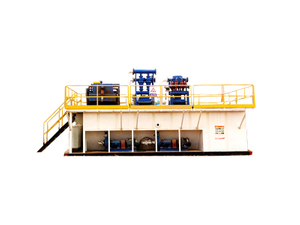
We recently completed production of a dual HZS604 linear motion shale shaker for a drilling mud application. Instead of bolting two standalone machines side by side and calling it a day, we engineered a proper parallel configuration: shared base frame, centralized mud distribution, synchronized but independent operation.
Each HZS604 brings the following specs to the table:
Item | Data |
|---|---|
Vibration trajectory | Linear motion |
Processing capacity | 144 m³/h (633 GPM) |
Screen area | 2.7 m² (29 ft²) |
Screen configuration | 4 panels, 1165 × 585 mm each |
Drive | 2 × 2.2 kW vibration motors |
Deck angle adjustment | -1° to +3° |
Overall dimension | 2650 × 1700 × 1750 mm |
Dry weight | 1950 kg |
Two units combined:
Total capacity: ~288 m³/h (1266 GPM)
Total screen area: 5.4 m²
Dual feed via shared distribution box — even split, no bias flow
Run both, or run one — the other stays on standby, gets serviced, or swaps screens without stopping the pit
Here's what happens when you size up from single to dual on the primary stage:
Peak return rates on large rigs routinely exceed what a single 144 m³/h shaker can handle—especially during tripping, surges, or high-RPM sections. With dual HZS604s online, you've got headroom built in. Mud stays on the screen. Cuttings convey off cleanly. No bypass.
Screen tears. Motors need inspection. It happens. On a single-shaker rig, that means stopping the pit or running a bypass line straight to the sand trap. On a dual unit, you lock out one side and keep drilling on the other. Zero downtime.
Because flow is split across two decks, linear velocity at the feed end drops. Less impact energy on the first screen panel means fewer premature tears and better overall screen economy—a direct cost saving that adds up over a multi-well campaign.
When primary separation does its job properly, desanders, desilters, and centrifuges downstream see less load. They run longer between cleanouts, consume fewer liners and rotors, and deliver tighter cut points. The dual shaker pays for itself by protecting the rest of the system.
We're not a trading company. We design, fabricate, and test every shaker in our own workshop. That means:
Welding quality control on the base frame to handle resonant vibration for 10,000+ hours
Precision-machined vibration motor mounts — no misalignment, no premature bearing failure
Spring isolator selection matched to deck weight and g-force target
Electrical integration — explosion-proof motors, starters, and junction boxes to IEC/ATEX standards
Customization — feed box orientation, discharge chute direction, screen mesh range (40–210 mesh), and skid height all adjustable to your tank layout
Every unit leaves our shop after a full no-load test: vibration amplitude check, motor rotation verification, screen tension inspection, and electrical function test. We don't ship surprises.
Application | Why It Works |
|---|---|
Deep well / high-RPM land rigs | Capacity headroom for surge returns |
Pad drilling (multi-well campaigns) | Continuous operation, easy screen change between wells |
HDD crossing projects | Handles variable return rates and mixed formation cuttings |
Shale gas / CBM operations | Oil-based and synthetic mud compatible |
Rig retrofits | Replaces single-shaker setups without re-engineering the entire mud system |
A shale shaker manufacturer can sell you a single machine. But if your operation is losing mud to overflow, burning screens, or stopping the pit for maintenance, you need more than a machine—you need a primary separation strategy.
The dual HZS604 is ours.
Capacity when you need it. Redundancy when you don't. Built by a vibration screen manufacturer that answers the phone after delivery.
We'll send you:
Dimensional drawings (DWG/PDF)
Capacity calculation based on your mud weight and flow rate
Screen mesh recommendation for your formation type
Lead time and FOB/CFR pricing
Contact our engineering team directly — no distributors, no markups, no runaround.